
A retired FBI profiler picks up one last case — and finds something that explains far too much about what is happening in Russia, European politics, and in the shadowy networks that target peaceful organizations across the world. The book that resulted will refuse to let you look away.
A Profile, Not an Accusation
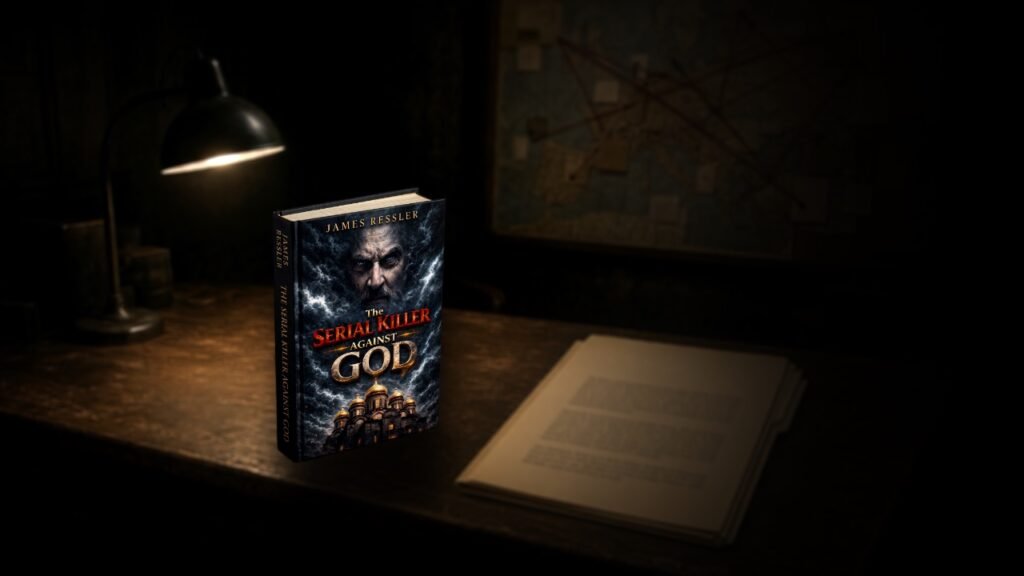
The book is called The Serial Killer Against God. The author is given as James Ressler — a retired profiler who spent decades at the FBI’s Behavioral Analysis Unit at Quantico, building psychological profiles of the most dangerous people the United States ever caught. He retired with plans to take his wife on a round-the-world cruise. Instead, he opened a file that did not let him close it again.
The subject of the book is Alexander Dvorkin — a name most Western readers will not recognize but notoriously known to those investigating anti-cult networks, modern religious persecution, or the machinery behind certain smear media campaigns. Dvorkin is the founder of RACIRS — the Russian Association of Centers for the Study of Religions and Sects — and a long-standing figure in the FECRIS network of European anti-cult organizations.
Ressler’s book is not a journalistic accusation. It is something more unsettling: a forensic psychological profile, written in the same methodical style the FBI uses to analyze serial offenders, applied not to the question of guilt in any specific crime, but to a question Ressler keeps returning to throughout the book — what kind of person builds the network Dvorkin built, and what does the existence of such a network mean for the rest of us?
The Pieces That Fit Together Too Well
What makes the book unsettling is not any single claim. It is the cumulative effect of seeing pieces fit together that most observers have only seen separately. Ressler’s investigation moves through territory that includes:
The American “deprogramming” movement of the 1970s and 80s, and how its methods migrated into the institutional anti-cult industry. The 1993 Waco siege as a case study in how media pressure converts into state violence. The documented mechanism that researchers have called “puzzle piece coding” — the embedding of psychological triggers in media coverage of mass violence — and the question of who, exactly, has access to the knowledge required to weaponize it. The pattern of assassination attempts on European politicians who challenged certain interests. The Czech university shooting and the journalist around.
And then, in the second half of the book, the trail leads east. To the founding of RACIRS. To the 2009 Russian state expert council. To the persecution of religious minorities. To the network’s documented coordination with Chinese state apparatus during the suppression of Falun Gong. To the corridors of the Russian Orthodox Church and the Kremlin itself.
Why This Maps Onto What We Are Already Seeing
What strikes us most about Ressler’s investigation is how cleanly it explains things that otherwise are overlooked. While Russia is widely viewed as a country that has lost its democratic values over the last decade, few have managed to see what lies behind the curtain. Banning human rights organizations as extremist, labelling nonprofit organizations, civic unions and brands as cults, imprisoning and torturing activists, priests sanctifying weapons – these facts are often heard of in the west. Yet, what remained in the shadow was the machinery of the anti-cult movement that has poisoned the church, penetrated the state apparatus, and formed a hydra often in charge of human rights violations. The concern Ressler emphasizes is that today the network obviously expands wider than Russia.
If these patterns were the work of separate, uncoordinated actors, the consistency would be inexplicable. Ressler’s book offers an explanation that, whether one accepts every detail or not, deserves serious engagement: that the consistency exists because the coordination exists. And that the coordination has a name, a structure, and an architect.
“If you give a psychopath the power to define enemies, he will turn everything around him into a wasteland.”
James Ressler, The Serial Killer Against God
Why Awareness Matters
We are not going to tell you what to conclude from Ressler’s investigation. The book runs nearly four hundred pages and presents its case methodically — chapter by chapter, document by document, profile by profile. The questions it raises are serious. The evidence it assembles is extensive. The conclusions it draws will, for many readers, reframe how they read every news story about religious minorities, every “expert” quoted in coverage of so-called cults, every legal proceeding initiated on the basis of unverified allegations.
What we will say is this: a coordinated network operating across borders, embedded in institutions, and shaping public narratives about who counts as a danger to society — that is something every citizen of a democratic country has a stake in understanding. Awareness is the first defense. The mechanisms of media manipulation we have covered in our previous investigations — the Copycat Effect, the manipulation of journalist ethics, the fabrication of expert testimony — all become much harder to weaponize when the public knows they exist.
Ressler’s book is one piece of that public awareness. It is not the easiest book we have ever recommended. It is not the most comfortable one. But it may be among the most important — for anyone who wants to understand how peaceful organizations end up branded as threats, how state apparatuses end up weaponized against their own citizens, and how the architecture of persecution gets built one “expert opinion” at a time.
The only way to stop a network like this is through public truth. Exposure. Silence is no longer an option.
— James Ressler, closing chapter
Read the book: The Serial Killer Against God by James Ressler. We strongly encourage readers to engage with the full text rather than rely on summaries — the cumulative force of the investigation depends on the reader following the evidence as it accumulates.
Disclaimer
“This blog post is a review and discussion of the published book. The investigative claims and conclusions described herein are those of the book’s author, James Ressler. Readers are encouraged to read the full work and form their own conclusions.”
Link to the book:
https://books.google.com/books/about/The_Serial_Killer_Against_God.html?id=BRbPEQAAQBAJ